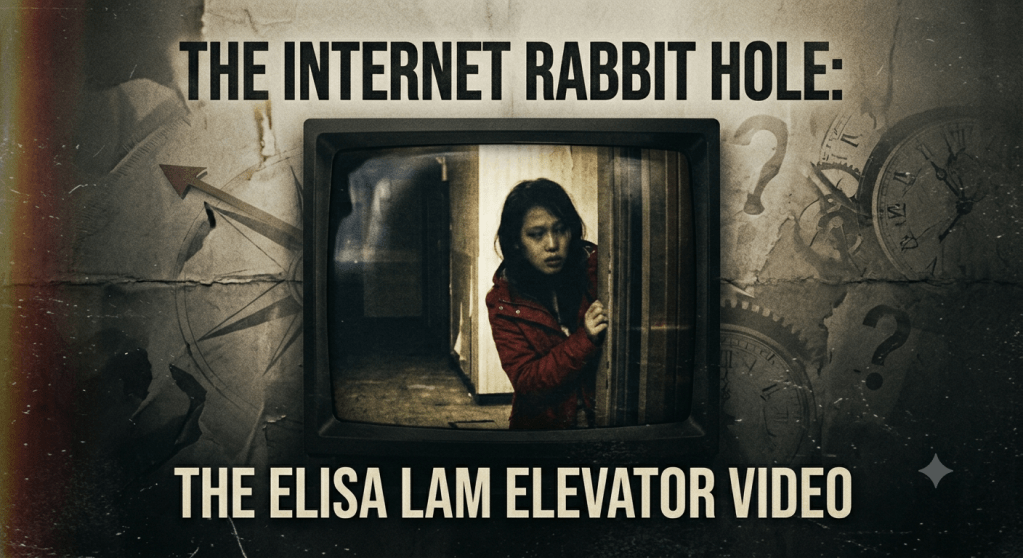
The ambient hum of the Cecil Hotel elevator is audible only in the low-frequency hiss of a low-res video file. It’s February 2013. The LAPD has just uploaded a four-minute clip to the internet, hoping a citizen might recognize the 21-year-old Canadian tourist inside.
Instead, they unleashed one of the most consuming, obsessive internet rabbit holes in digital history.
If you watched it late at night in 2013, the video felt less like a police appeal and more like a cursed file. Elisa Lam steps into the elevator. She presses a vertical column of buttons. The doors don’t close. She waits, then peers out into the hallway, jerking her head left and right with an uncanny, mechanical rhythm. She steps back, pressing herself flat against the corner wall as if trying to vanish into the plastic paneling.
Then come the hands.
She steps out into the hallway—the camera’s blind spot—and her hands begin to move. It’s a fluid, swimming motion, her fingers splaying out in geometric patterns, waving at an empty corridor. Moments later, she walks away into the darkness. The elevator doors, completely indifferent, finally slide shut.
Elisa Lam was never seen alive again.
The Echo Chamber Unleashed
Within hours of its upload, the video migrated from police servers to YouTube, Reddit, and Webleuths. It became a digital Rorschach test. Where detectives saw a missing person, the internet saw a horror movie waiting to be solved.
Amateur sleuths went to work with the fervor of digital archeologists. They noticed details that felt deeply wrong:
- The video timestamp was heavily blurred.
- The footage seemed artificially slowed down in places.
- The elevator doors remained open for nearly two minutes—a defiance of basic hotel mechanics.
The theories bloomed like mold in the dark corners of the web. Some swore they saw the shoe of a second person in the corner frame. Others blamed the supernatural, citing the Cecil Hotel’s notoriously blood-soaked history. For weeks, the internet argued over a ghost story.
Then, the water turned black.
The Grim Discovery at the Cecil
Nineteen days after Elisa vanished, the narrative shifted from eerie to visceral.
Guests at the Cecil Hotel had been complaining for days about a horrifying reality: the water pressure in their rooms was a sluggish trickle. Worse, the water coming out of the taps was dark, metallic, and tasted strange.
On February 19, a maintenance worker climbed the stairs to the roof, walked past the security alarms that somehow hadn’t triggered, and scaled a ladder to the hotel’s four massive, 1,000-gallon water tanks. He opened the hatch.
There, floating face-up in the water that guests had been using to brush their teeth and bathe, was Elisa Lam. She was completely naked, her clothes floating beside her, heavy with sediment.
The Seduction of Conspiracy
If the elevator video was fuel, the discovery of the body was an explosion. The internet refused to accept the official narrative. How could a 5,0-foot, petite woman lift a heavy, hinged steel water tank lid by herself, climb inside, and close the lid behind her?
The rabbit hole deepened when sleuths discovered an impossible coincidence. During Elisa’s stay, Los Angeles was suffering from an outbreak of tuberculosis. The specific enzyme test used to screen citizens in the area was named LAM-ELISA (Lipoarabinomannan Enzyme-Linked Immunosorbent Assay). To the conspiratorial mind, Elisa wasn’t a victim; she was a biological weapon or a government whistle-blower executed by dark forces.
Web sleuths even hounded a random regular guest of the hotel—a black metal musician named Morbid—ruining his life and driving him to psychiatric distress, simply because his edgy music videos featured horror themes that aligned with their dark fantasies.
The Quiet, Tragic Reality
When the coroner’s report finally dropped, it didn’t contain ghosts, cloaked assassins, or government bioweapons. It contained a devastating medical reality.
Elisa Lam’s death was ruled an accidental drowning, with her bipolar disorder listed as a significant factor.
The toxicology report revealed something vital: Elisa was taking a cocktail of medications to manage her severe bipolar disorder. However, the trace amounts of the drugs in her system showed she had recently stopped taking them. She was “under-medicated.”
When a person with severe bipolar I drops off their medication, it can trigger a sudden, catastrophic psychological break. The behavior in the elevator—the hiding, the erratic head movements, the strange hand gestures—wasn’t an encounter with a demon. It was the visual manifestation of intense paranoia and visual or auditory hallucinations.
Elisa likely believed she was being hunted. In a desperate attempt to hide from her own mind, she fled to the roof—accessible via fire escapes that bypassed the alarmed doors. She saw the water tanks as a hiding place, climbed in, and accidentally trapped herself. As for the “heavy lid”? The maintenance worker later testified that the hatch was actually open when he found her. The rumor that it was locked shut from the outside was just an early, unverified piece of internet telephone.
The True Monster of the Story
The true horror of the Elisa Lam story isn’t the Cecil Hotel, nor is it the eerie elevator video. The true horror is how easily the internet can take a real-world mental health tragedy, strip away the victim’s humanity, and reformat it into a piece of digital entertainment.
Elisa Lam was a daughter, a writer, and a young student struggling with a heavy invisible illness far from home. The elevator video remains online, viewed hundreds of millions of times, a permanent digital monument not to her life, but to the moment her reality broke apart.



Leave a comment