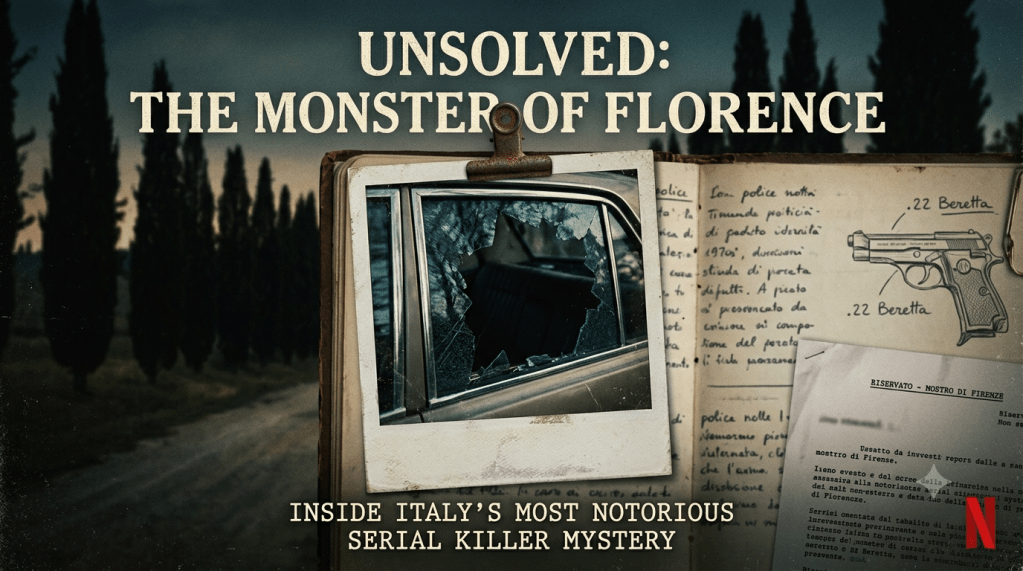
Tuscany is famous for its rolling hills, sun-drenched vineyards, and Renaissance art. But beneath the postcard-perfect beauty lies a shadow that has haunted the region for nearly forty years.
Between 1968 and 1985, a shadow known only as The Monster of Florence (Il Mostro di Firenze) turned the romantic outskirts of Florence into a landscape of absolute terror. Targeting young lovers parked in secluded lanes, this faceless entity committed eight double murders, cementing himself as Italy’s first and most brutal serial killer.
Decades later, the case remains a labyrinth of botches, dead ends, and chilling theories. It is a story so gripping and complex that director Stefano Sollima has brought it to life in a dark, atmospheric limited series. If you want to watch the madness unfold on screen, you can dive straight into The Monster of Florence on Netflix
The Anatomy of Terror: 17 Years, One Weapon
The Monster’s signature was exact, cold, and terrifyingly consistent.
Over a span of seventeen years, sixteen lives were taken. In almost every case, the killer targeted couples looking for privacy in their cars. The weapon was always the same: a .22 caliber Beretta pistol loaded with rare, Winchester “Series H” ammunition.
But what truly shocked the world wasn’t just the execution—it was what happened next. The killer surgically mutilated several of the female victims, leaving investigators with crime scenes that pointed to a deeply disturbed, yet calculated, individual.
A Labyrinth of “Possible Monsters”
What makes the Monster of Florence true story so infuriatingly fascinating is the investigation itself. Instead of a linear hunt for a single suspect, the case fractured into a chaotic web of conspiracy theories:
- The Sardinian Lead: Early investigations focused on a tight-knit, insular group of Sardinian immigrants, resulting in wrongful arrests and massive systemic confusion.
- The “Picnicking Companions”: Years later, authorities convicted a local farm worker, Pietro Pacciani, and his alleged accomplices. However, Pacciani’s conviction was later overturned on appeal due to sloppy police work, and he died before a retrial could occur. Experts have long questioned whether these marginalized men actually had the precision to pull off the crimes.
- The Occult Cult Theory: As the years rolled on, theories grew increasingly bizarre. Prosecutors alleged that the killer wasn’t acting alone, but was providing body parts to a wealthy, shadowy network of occultists, doctors, and secret societies operating out of the elite villas of Tuscany.
None of these theories have ever been definitively proven with forensic evidence. To this day, the Beretta pistol used in all sixteen murders has never been recovered.
“Horror, to be truly told, must be faced, not avoided… Not to solve, not to explain, but simply to remember.” — Stefano Sollima, Director of the Netflix Adaptation
The Timetable of Terror: A Pattern Emerges
The true scope of the horror becomes clear when you trace the exact evolution of the killer’s pathology. The Monster didn’t just kill; his methods grew increasingly gruesome:
- The 1968 Prelude: 32-year-old Barbara Locci and her lover, Antonio Lo Bianco, were shot to death in a car outside Signa while Locci’s 6-year-old son slept undisturbed in the back seat.
- The Escalation (1974): Teenage lovers Pasquale Gentilcore and Stefania Pettini were ambushed. Pettini’s body was stabbed 97 times and horrific post-mortem mutilation was introduced—a signature that would define the Monster’s work.
- The Summer of Panic (1981): Two separate engaged couples (Carmela De Nuccio & Giovanni Foggi, and Stefano Baldi & Susanna Cambi) were slaughtered months apart. This sparked mass hysteria in Florence once ballistics confirmed that the exact same .22 Beretta from 1974 was back in use.
- The Final Strike (1985): French tourists Jean Michel Kraveichvili and Nadine Mauriot were targeted while camping in a forest. In a final, brazen taunt, the killer cut off a piece of Mauriot’s body and mailed it to the lead prosecutor, Silvia Della Monica.
The Botched Legacy of the “Snack Buddies”
If you find yourself shouting at the screen during the Netflix series, it’s likely due to the chaotic twist the investigation took in the early 1990s.
After abandoning the failed “Sardinian Trail” (where police wrongfully detained an entire web of immigrants based on shifting confessions), prosecutors pivoted to an aggressive local farmer named Pietro Pacciani. Pacciani was a man with a violent past, but zero forensic evidence connected him to the precise, surgical cuts found on the victims.
When Pacciani’s initial conviction was overturned on appeal, the police scrambled and constructed a theory around his heavy-drinking friends—Mario Vanni and Giancarlo Lotti—affectionately dubbed the Compagni di Merende (“Snack Buddies”) by the Italian media. Though Vanni and Lotti were ultimately convicted for some of the murders based on a series of highly contradictory confessions, criminologists worldwide largely view them as scapegoats rather than the mastermind behind a 17-year crime spree.
Why It Remains the Ultimate Cold Case
Even today, modern science has failed to crack the case. Recent attempts to harvest DNA from a bullet casing found at the 1985 French tourists’ crime scene yielded a male profile. However, it didn’t match any of the convicted suspects. Because decades of sloppy evidence handling mean the DNA could belong to a careless investigator, the lead remains a dead end.
To this day, the true identity of the Monster of Florence remains buried in the Tuscan hills.
Why the World is Obsessed with the New Netflix Series
True crime fans are calling the new four-part series the Italian equivalent to David Fincher’s Zodiac. The show intentionally avoids taking a definitive stance on who the real killer was. Instead, it places the viewers directly into the paranoia of the era, focusing heavily on how hysteria and flawed assumptions destroyed the lives of the accused.
Filmed with intense historical accuracy and pulling directly from real Italian court documents and testimonies, it is a slow-burn psychological thriller that doesn’t hold back on the dark, gritty atmosphere of 1970s and 80s Italy.
The mystery remains alive. Was the Monster a lone madman, an intricate cult, or someone completely overlooked by history? Watch the official preview to experience the chilling atmosphere of the investigation for yourself through The Monster of Florence Official Trailer, which gives an eerie look into the atmosphere of fear that took over Tuscany.
This video link takes you directly to the cinematic trailer provided by Netflix, offering a visual window into the historical accuracy, dark tone, and tension that defined this real-life investigation.


Leave a comment