The clock on the wall read 9:14 PM. It was a rainy Sunday night in Chicago—November 22, 1987.
At WGN-TV, sports anchor Dan Roan was summarizing a Chicago Bears victory. Suddenly, the screen went pitch black.
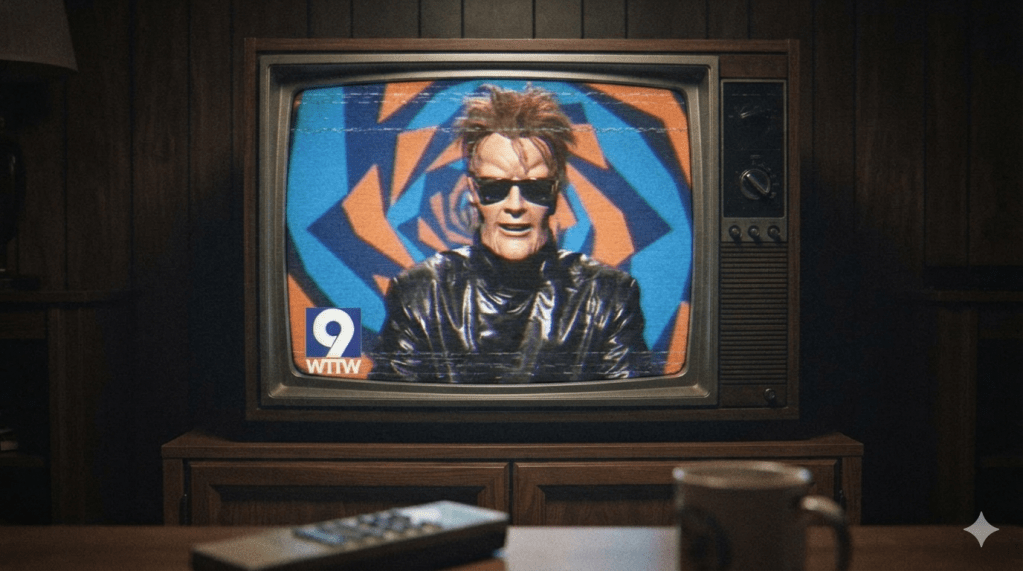
When the picture flickered back to life, Roan was gone. In his place stood a figure wearing an oversized rubber mask of Max Headroom—the era’s popular, glitchy AI marketing icon.
The figure rocked frantically against a spinning piece of corrugated metal. There was no audio, only a piercing, industrial hum.
The First Strike
For thirty agonizing seconds, control room technicians scrambled. The hijackers had overpowered WGN’s microwave signal to its transmitter tower.
By the time engineers switched frequencies, the masked intruder vanished. Dan Roan reappeared on screen, visibly shaken.
“Well, if you’re wondering what happened, so am I,” Roan muttered to a stunned audience.
But the phantom broadcaster was not done yet.
“Catch the Wave”
Two hours later, over at PBS affiliate WTTW, thousands of sci-fi fans were settled in for an episode of Doctor Who. At 11:15 PM, the screen shattered into static again.
Max Headroom was back. This time, the audio worked.
The voice was distorted, manic, and terrifyingly chaotic. The figure mocked WGN sports anchors, screamed random phrases, and held up a fake hand.
“He’s a frickin’ nerd!” the hacker yelled. He began humming the theme song to the 1960s cartoon Clutch Cargo.
Then, the broadcast took a truly surreal turn. The camera panned down.
The hacker had dropped his trousers. A woman in a maid outfit was spanking his bare backside with a flyswatter.
“They’re coming to get me!” he shrieked. Ninety seconds later, the signal cut out, and Doctor Who abruptly resumed.
Anatomy of a Perfect Cyber Heist
The next morning, the Federal Communications Commission (FCC) and the FBI launched a massive manhunt. Hijacking a television signal was a federal crime.
Investigators quickly figured out how it happened:
- The hackers positioned themselves on a high rooftop with a clear line of sight to the stations’ broadcast towers.
- They used highly specialized, expensive microwave transmission gear.
- They simply overpowered the studio’s signal by blasting a stronger frequency at the antenna.
Yet, despite knowing the physics, the feds hit a brick wall.
The Silent Ghosts
The equipment required was rare, but not impossible for a dedicated hobbyist or television engineer to acquire.
The most baffling part? The hackers never stepped forward.
Usually, pranksters of this scale want the clout. They want to brag. But for nearly forty years, the Chicago hackers have kept completely silent.
Popular internet theories suggest the culprits were two eccentric brothers from the Chicago underground punk-tech scene. Others believe it was an inside job by a disgruntled television employee.
Today, the Max Headroom incident remains the most famous, unsettling, and successful broadcast signal intrusion in history. The entities behind it remain faceless ghosts, lost to the analog static of 1987.



Leave a comment